August Morning Work - Back to School
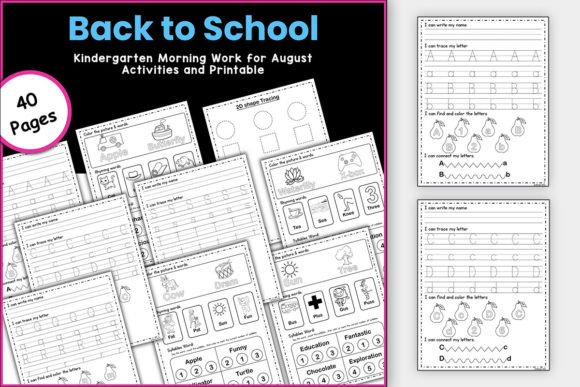
Starting the school year with consistency and calm makes all the difference—especially in kindergarten. August Morning Work - Back to School is a thoughtfully designed, print-ready resource that helps teachers establish a smooth, predictable, and standards-aligned start to each day. It’s not just busywork—it’s purposeful practice: 40 pages of literacy and math activities built around early learning priorities like name writing, letter and number tracing, one-to-one correspondence, rhyming, color words, syllables, and shape identification. Each page follows a consistent layout so students build independence fast—and you reclaim precious minutes for differentiation, assessment, or simply breathing.
Why educators reach for this resource—and why timing matters
August isn’t just about supply lists and seating charts. It’s when routines are set, expectations are modeled, and confidence begins to take root. Teachers who introduce structured morning work early report fewer transitions issues by week three—and stronger student ownership by October. This packet supports that shift with its clean 8.5×11 inch format (no bleed), available in PDF, PNG, and JPG—so whether you’re printing full-color sets, projecting on an interactive board, or uploading to a learning platform, it works without extra editing.
A common oversight: assuming “print-ready” means “plug-and-play”
Many buyers assume “print-ready PDF” guarantees perfect results—only to discover later that their printer crops margins, colors shift unexpectedly, or grayscale versions lose critical visual cues (like color-word matching). Here’s what often goes wrong:
- Skipping the file preview step. A PDF may look crisp on screen but render poorly if fonts aren’t embedded or if compression settings flatten fine lines—especially in tracing activities. Always open the PDF in Adobe Acrobat (not just a browser) and zoom to 200% to check line clarity and spacing.
- Mixing formats without testing. While the bundle includes 40 PNGs and 40 JPGs, those files are raster-based—not scalable. Enlarging a JPG beyond 100% for classroom posters can cause pixelation. For bulletin boards or digital display, stick to the PDF version; reserve PNGs for quick digital assignments where fixed size is acceptable.
- Overlooking page organization. The 40-page count includes monthly covers and answer keys (if applicable)—but not every page is student-facing. Skim the included table of contents first. Some users accidentally assign cover pages as worksheets or miss the intentional skill progression across weeks.
Another frequent misstep: underestimating setup time
“High-quality print ready” doesn’t mean zero prep—but it *does* mean minimal prep. Still, skipping small steps adds up. One teacher printed all 40 pages double-sided, only to realize half the tracing pages had faint guide lines on the back that bled through. Another loaded PNGs into Seesaw without renaming files, making assignment tracking chaotic across 25 students.
Better approach? Do a test run with just the first five pages: print one copy, check alignment and contrast, then batch-print the rest. Rename digital files before uploading—e.g., “Aug_MW_LetterTracing_A–C.pdf”—so they sort logically in your drive or LMS. And if using for centers, consider laminating only the most reused pages (like shape tracing or rhyming cards) instead of the full set. You’ll extend longevity without overcommitting laminator time.
What to verify before downloading or purchasing
Before clicking “buy,” scan these details—not as checkboxes, but as quality signals:
- Page size confirmation. The spec says 8.5×11 inches—no bleed. That means no extra margin for trimming. If your district uses specific paper trays or printers with tight tolerances, confirm compatibility. Avoid resources labeled “designed for US Letter” without explicit 8.5×11 dimensions—some list “Letter” but export at 8.27×11.69 (A4), causing scaling surprises.
- Format flexibility. Does the listing clearly state that all 40 pages exist in all three formats (PDF, PNG, JPG)? Some sellers include only the PDF and add “PNG/JPG available upon request”—which delays implementation. With August Morning Work - Back to School, you get all three, upfront.
- Standards alignment transparency. Look for references—not just “Common Core aligned”—but *which* standards (e.g., RF.K.1d for letter recognition, K.CC.B.4 for counting). Vague claims make lesson planning harder. This resource maps directly to foundational ELA and Math domains, so you can cite them in plans or share with curriculum coordinators confidently.
How presentation affects engagement—and why it’s worth checking
Kindergarteners respond strongly to visual clarity. Thin lines, low-contrast text, or cramped spacing increase frustration—not learning. In one classroom, students repeatedly skipped the syllable-clapping activity because the icons were too small and unlabeled. The fix? Using the high-res PNG version projected on the whiteboard, then circling key elements together during the first modeling session.
That’s why the included 40 PNGs matter: they’re optimized for projection—crisp at 150% zoom, legible even in slightly dimmed rooms. But don’t assume all PNGs are equal. Check resolution metadata if possible (aim for ≥300 DPI at 8.5×11). If downloading from a marketplace without specs, email the creator and ask. Reputable sellers respond promptly—and if they don’t, that’s useful intel about support quality.
Final note: It’s not about more pages—it’s about better starts
Forty pages sounds substantial—until you realize it’s five weeks of daily work, five days a week. That’s sustainability, not overload. What makes August Morning Work - Back to School effective isn’t volume—it’s intentionality. Every tracing path reinforces pencil control. Every color-word match builds vocabulary *and* visual discrimination. Every number ID task embeds counting logic before formal instruction begins.
So before you print, project, or assign: pause and ask, “Does this help my students feel capable—not just occupied?” If yes, you’ve chosen well. If not, revisit the preview files, test one page, and adjust. Great teaching isn’t about flawless resources—it’s about using the right tool, the right way, at the right time. And for August mornings? This one earns its place on your desk, your screen, and your students’ first weeks of learning.